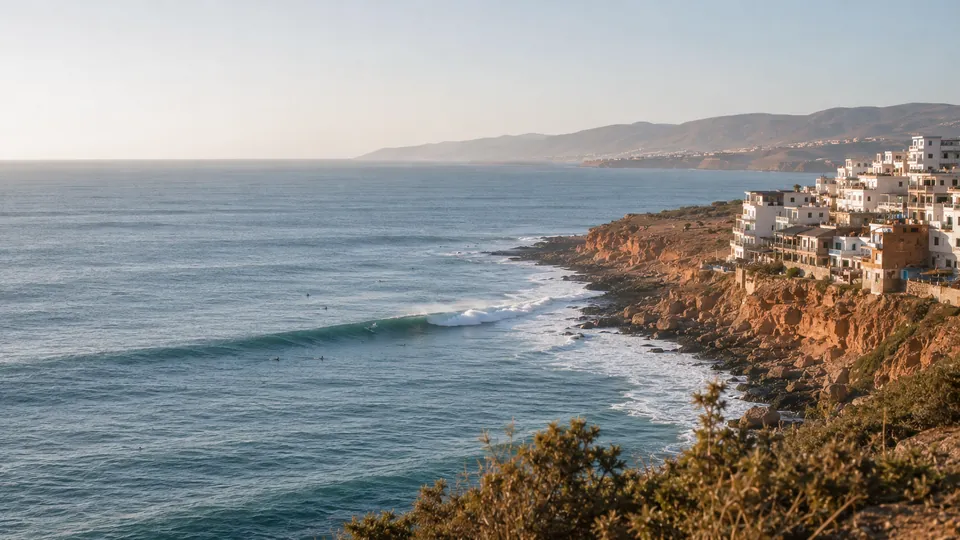
On this coast the tide is not a refinement, it is the timetable. Two of the four most-named breaks around Taghazout only work at low tide, and a third only on a rising high. Driving out in the morning without that is watching a coast that is working elsewhere.
The break plan
Of twelve documented breaks, eleven state a preferred tide.
| Spot | Village | Tide | Level |
|---|---|---|---|
| Anchor Point | Taghazout | low | advanced to expert |
| Hash Point | Taghazout | low | intermediate |
| Panoramas | Taghazout | low | intermediate |
| La Source | Taghazout | high | intermediate |
| Mysteries | Taghazout | high | advanced to expert |
| Killer Point | Taghazout | any | advanced to expert |
| Banana Beach | Tamraght | high | beginner |
| Devil's Rock | Tamraght | mid | beginner |
| Banana Point | Tamraght | any | beginner |
| Cathedral Point | Imsouane | low | intermediate |
| La Baie | Imsouane | any | beginner to advanced |
Two things stand out. The Taghazout points split: three at low tide, two at high. So there is almost always one working, provided you are willing to change break rather than hour.
And three breaks work on every tide: Killer Point, Banana Point and Imsouane bay. That is why the Imsouane day belongs mid-week: you stay in the water as long as it holds, instead of waiting for a window.
What it means for a week
A well-built week alternates between tides instead of forcing one break.
- Low tide in the morning: Anchor Point, Hash Point or Panoramas, depending on level.
- High tide in the morning: La Source, or Banana Beach for a beginner.
- The day with no window that fits: Imsouane, and the day is saved.
Wind decides the other half. It is workable 57 % of the time in winter and comes up during the day, which is why sessions run in the morning. Tide and wind together give a window of two to three hours in practice, and a camp that picks its break in the morning rather than the night before earns its price for exactly that reason.
What is not here
No times and no tidal coefficients. Those change daily and are in any forecast; what does not change is which break wants which tide, and that is the column you need to plan.
For Boilers no guide states a preferred tide, and none does for Imsouane bay either. The row stays empty rather than inventing one.
Frequently asked
How long between two tides?
About six hours between high and low, so two usable windows a day for a break with a fixed tide.
Can you surf on the wrong tide?
Often yes, just worse: more sections, less length, and more people on the one peak that works. At Anchor Point the difference is obvious.
Does it matter for a beginner?
Less, and that is an advantage. Banana Point and the bay work on every tide, Devil's Rock at mid: a beginner week barely depends on the clock.
Every break has its own sheet, listed on surf spots in Morocco.